When Does GraphRAG Help? A Controlled Study of Evidence Localization in Long Annual Reports

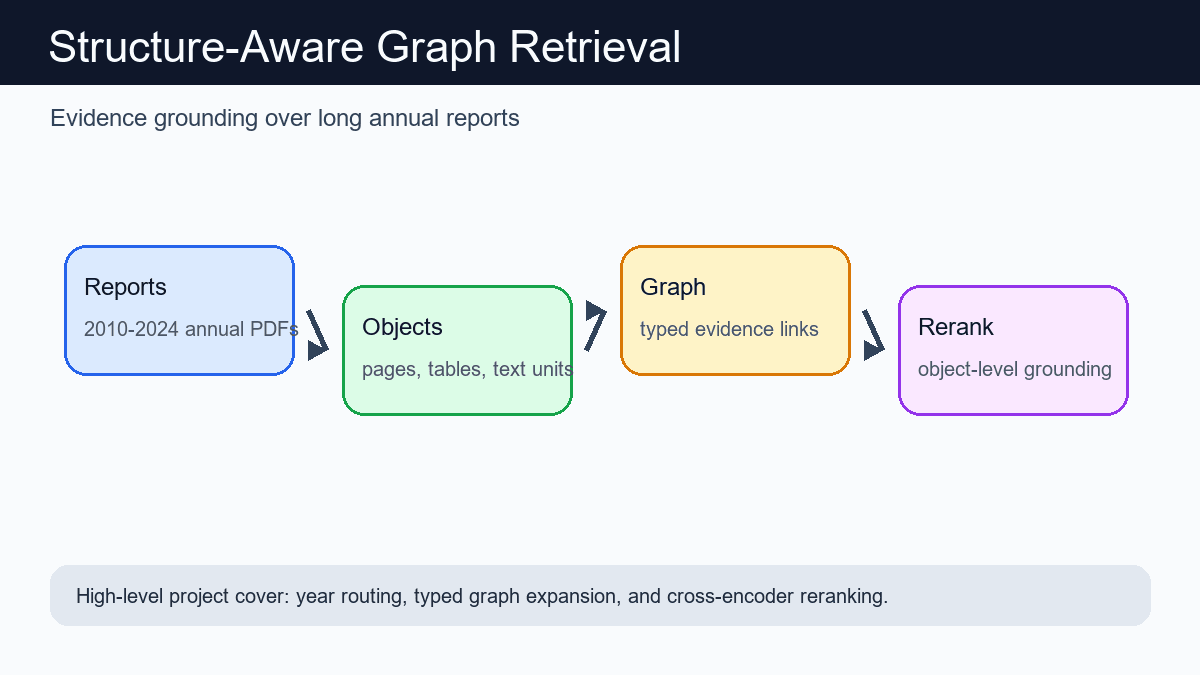
85.9%
Object Recall@10
91.8%
Page Recall@10
48,292
Graph nodes
Tech Stack
Description
This project explores graph-based evidence retrieval from long annual reports. The graph connects related evidence through shared entities and financial metrics. As first author and experimental lead, I designed the GraphRAG approach and led the experiments and evaluation.
- Built a GraphRAG system to find supporting evidence in long annual reports using document structure, entities, and financial metrics.
- Compared standard retrieval with graph-based retrieval, finding that graph expansion improved evidence-object recovery while graph paths added page coverage.
- Analyzed which graph relations helped or harmed retrieval through edge ablations, paired bootstrap tests, and a held-out-year robustness check.
Research Questions
Which structural relations are useful for evidence retrieval, and which introduce noise?
What do selected-graph expansion and graph-path retrieval contribute beyond a strong hybrid retriever under controlled conditions?
How do structure-aware retrieval methods behave on multi-hop and visual/layout-sensitive questions?
Method overview
GraphRAG as Controlled Evidence Navigation
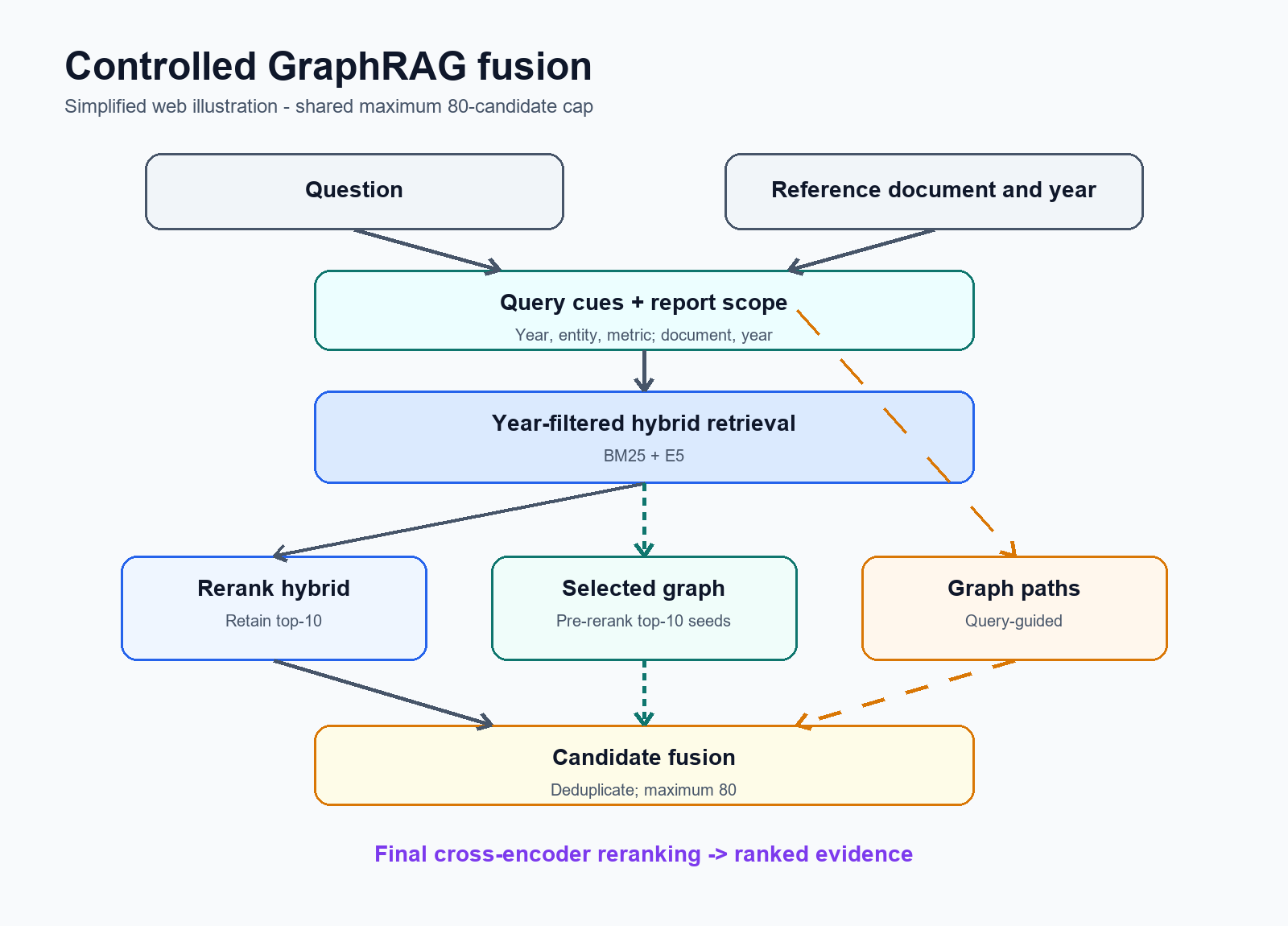
Standard retrieval finds evidence mainly through text similarity. Our GraphRAG approach also uses document structure, connecting evidence through shared pages, entities, and financial metrics. The goal is to test whether these graph connections can recover useful evidence that standard retrieval misses.
The system combines evidence from three sources: hybrid retrieval provides the original results, selected-graph expansion finds related evidence from those results, and graph paths independently find evidence using cues from the question. All candidates are then combined and reranked.
RQ1. Which Graph Connections Help?
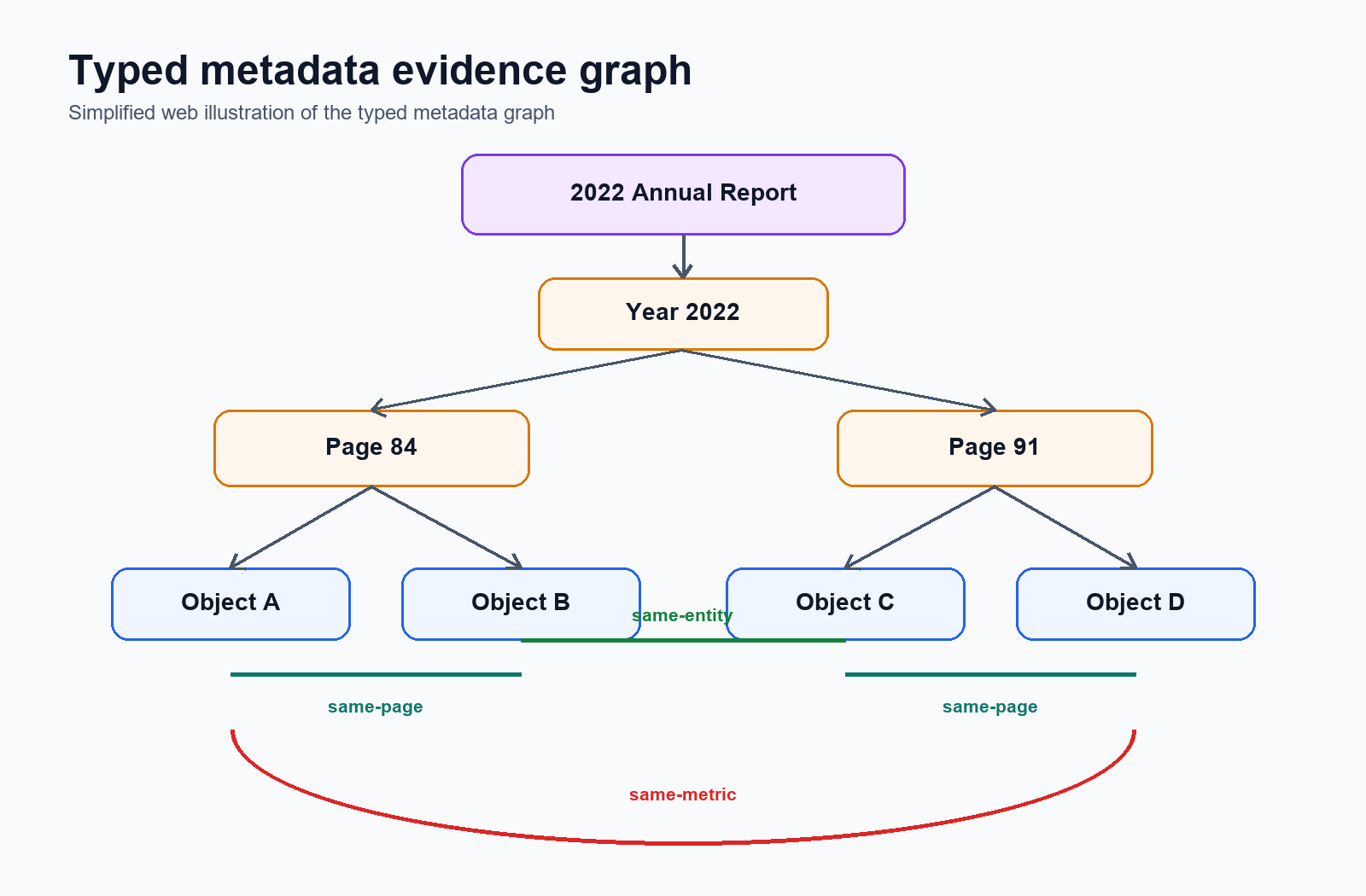
The graph connects evidence in four ways: evidence can appear on the same page, mention the same entity, refer to the same financial metric, or appear on adjacent pages.
We test these connections one at a time to see which ones help GraphRAG find the right evidence and which ones introduce noise.
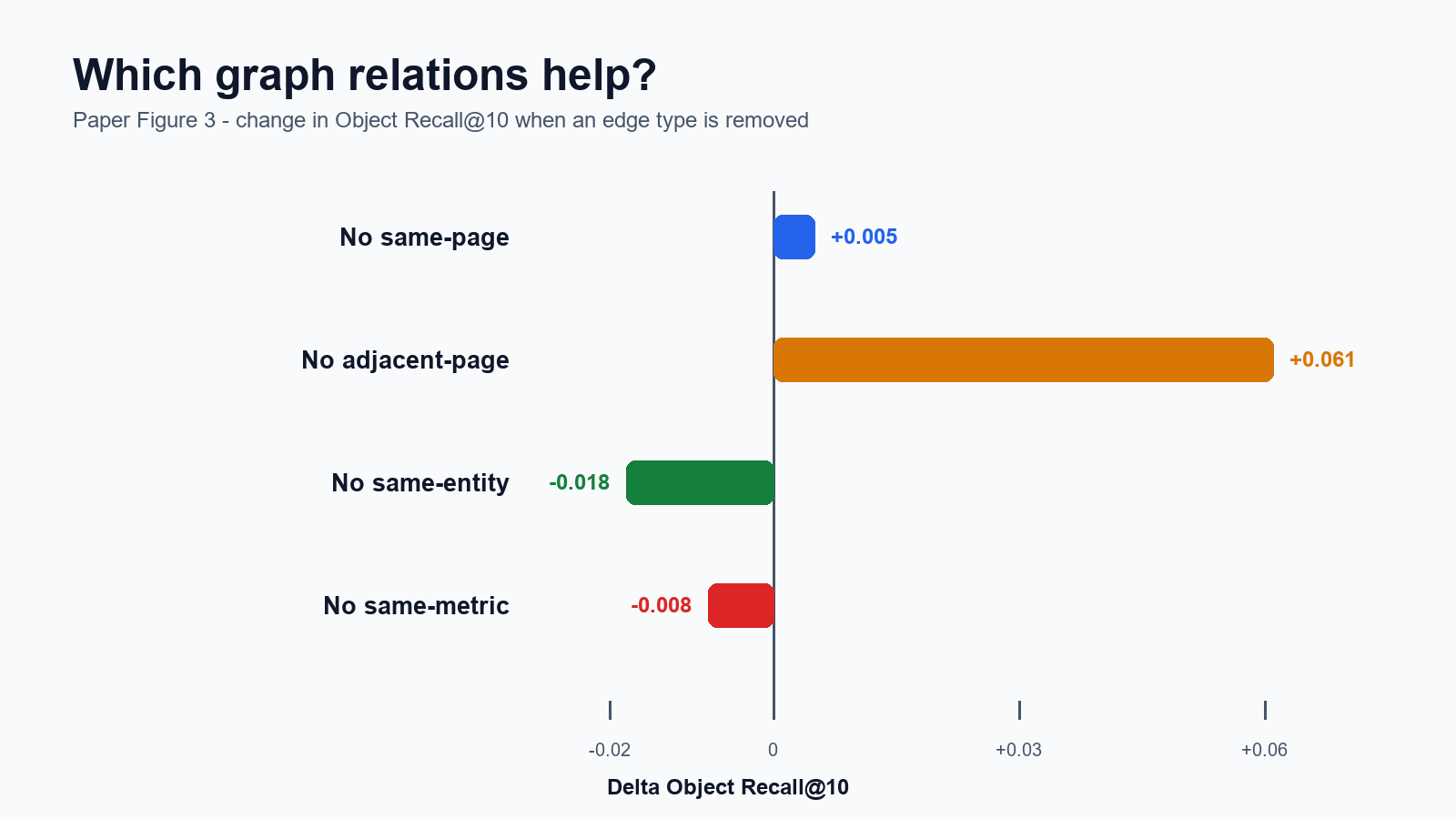
The results show that same-entity connections are the most useful, while same-metric connections provide a smaller benefit. Same-page connections have limited impact. Adjacent-page connections are harmful because they bring in distracting evidence from nearby pages.
Does This Finding Hold in Later Reports?
Our main analysis shows that adjacent-page links can introduce noise and hurt retrieval. We repeat the comparison on reports from 2022–2024 to see whether the same finding holds in later years.
| Metric | With adjacent-page links | Without adjacent-page links |
|---|---|---|
| Object Recall@10 | 70.0% | 84.7% |
| MRR | 0.633 | 0.729 |
Removing adjacent-page links again improves retrieval, suggesting that this effect is consistent across different years within the Equinor reports. This check does not test generalization to other companies or document collections.
RQ2. What Does Each Graph Source Add?
We compare the original hybrid retrieval with two graph-based methods: Selected Graph and Graph Paths. The original hybrid results are kept, and each graph method adds additional evidence before the final ranking.
| Method | Object Recall@10 | Page Recall@10 |
|---|---|---|
| Hybrid E5 | 83.8% | 90.8% |
| + Selected Graph | 85.6% | 90.3% |
| + Graph Paths | 85.0% | 91.4% |
| + Graph + Paths | 85.9% | 91.8% |
The two graph methods help in different ways. Selected Graph improves the retrieval of specific evidence, increasing Object Recall@10 from 83.8% to 85.6%. Graph Paths mainly help find relevant pages: when added to Selected Graph, Page Recall@10 increases from 90.3% to 91.8%.
Together, Graph + Paths gives the best overall coverage, reaching 85.9% Object Recall@10 and 91.8% Page Recall@10.
RQ3. Where Does Retrieval Still Fail?
Even with graph-based retrieval, two challenges remain: finding all the evidence needed for multi-hop questions and finding the exact evidence inside visually complex pages.
Multi-Hop Questions
Some questions require evidence from multiple places in the reports. Finding only one of them is not enough.
| Retrieval Result | Hybrid E5 | + Graph + Paths |
|---|---|---|
| At least one evidence object found | 100.0% | 100.0% |
| All evidence objects found | 67.8% | 72.2% |
| All evidence pages found | 71.1% | 74.4% |
Both methods can always find some relevant evidence. The harder problem is finding all the evidence needed for the question. Adding Graph and Paths improves this from 67.8% to 72.2%.
Visual and Layout Questions
For questions involving tables, figures, or page layout, the system may find the correct page but still miss the specific evidence on that page.
| Retrieval Result | Hybrid E5 | + Graph + Paths |
|---|---|---|
| Evidence object found | 41.1% | 50.0% |
| Evidence page found | 73.3% | 78.9% |
This gap is still large. With Graph and Paths, the system reaches the correct page in 78.9% of cases, but finds the specific evidence in only 50.0%.